Copycat (1995): the Platonic Ideal of Serial Killer Media

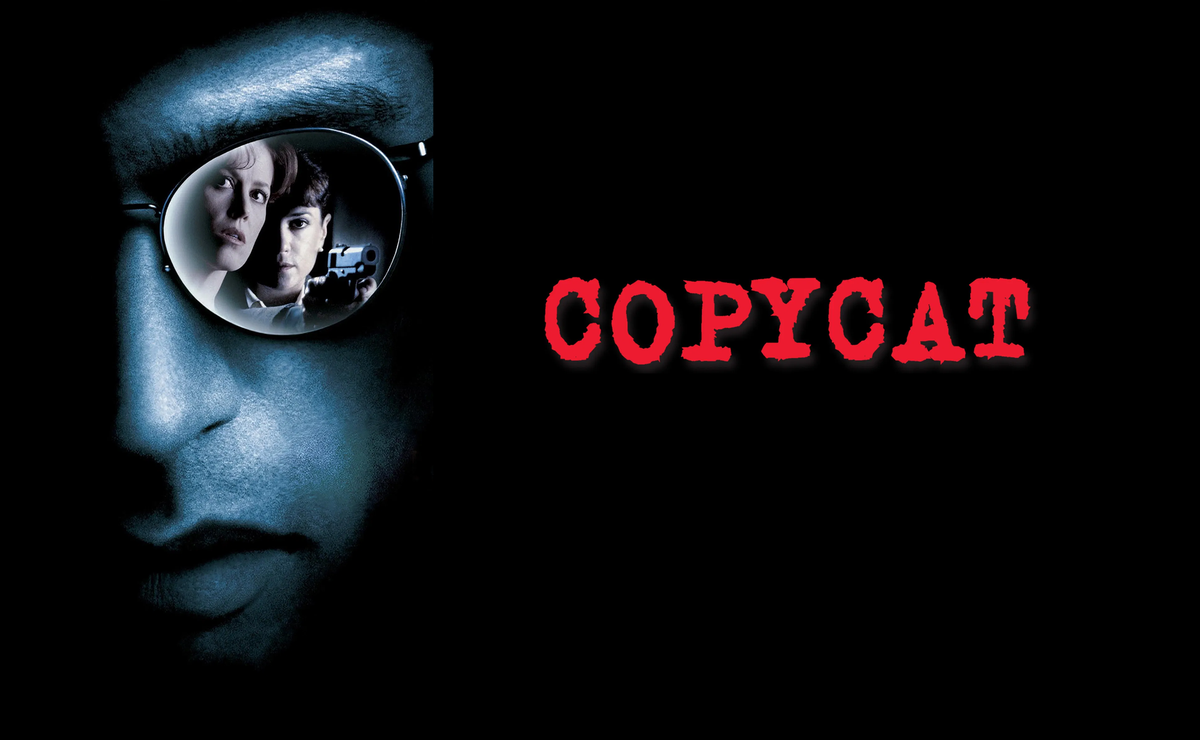
Copycat is a meta serial killer procedural, following two female protagonists, a psychologically traumatised civilian profiler and a competent but idealistic police investigator, navigating the world of violent men (cops, criminals & killers) forced to collaborate with a Hannibal Lecter-meets-Charlie-Manson-analogue uber-serial killer, in order to capture a newly active serial killer who is copying the crimes of real life killers.
If you only ever watch one serial killer movie, make it this one. It is peak serial killer media; it takes on a broad genre and its predecessors, adds in a meta layer of real life true crime, and locks in the tropes, archetypes, and conventions that thrillers still follow (or try to subvert) to this day.
There's a long history of serial killers in movies, and one of the first set the template: Fritz Lang's M with Peter Lorre's Hans Beckert (an amalgamation of Peter Kurten and other active German serial killers prior to 1931) echoes through characterisation and story beats to this day. Every decade that followed kept giving fictional serial killers a place in the consciousness of the public and an ongoing life as film villains and anti-heroes.
While the 40s and 50s had their own fair share of serial killer depictions, it's 1960 with Psycho and Peeping Tom that created the initial framework for the slashers of the 70s Black Christmas (1974) and Halloween (1978) and eventually Copycat. In the same decade, films like Dirty Harry (1971) were keeping the serial killer procedural equally at the top of the box office: Clint Eastwood hunting down Scorpio, the paedophilic sadomasochist killer of children (as an analogue for the Zodiac killer who committed his murders a few years prior and was still in ongoing communication with the police at the time).
During this time serial killers in media are shown as pathetic creatures; while scary, they are ultimately pitiful and pedestrian. They may be elusive like Jack the Ripper but (if caught) revealed as nothing more than broken people. Norman Bates might be charming, but he's still an Oedipus-complex poster child and a tragic figure, driven by uncontrollable desires rather than intellect. The proto-slasher serial killer, like Lorre's character 40 years earlier, doesn't want to kill: he is compelled to do so and is unable to stop.
Once we move to the early 70s, the line between nurture vs. nature begins to blur when it comes to motivating the serial killer. The killer becomes more abstract and opaque: a disembodied voice on a phone or The Silhouette in the distance. Even when the serial killer is known, he now embraces his nature: Scorpio is a serial killer who enjoys being a serial killer and has no desire to stop. The politics and how serial killers should be dealt with are changing as well: while M has the police prevent mob justice, Dirty Harry has a police officer deliver mob justice. You no longer attempt to cure or understand the serial killer, you put them down before they can kill again; a plot-device clearly driven by psychiatric science's inability to "cure" or prevent serial killers.
And then in the 80s, Thomas Harris happened and the elevating of serial killers to mythic status truly began. The movie adaptations of his works give us an arc for the evolution (and eventual devolution) of the serial killer:
- Manhunter (1986): the Tooth Fairy is grounded in the pre-80s serial killer pathology that we can just about understand, while mythologising the serial killer through the sophisticated ironically layered psychiatrist cannibal gourmand Hannibal Lecter. We're also introduced to Will Graham, the archetype of the troubled profiler whose weaponised empathy allows them to understand these monsters but at a cost to their own sanity.
- Silence of the Lambs (1991): Hannibal is now a fully mythic and ascended serial killer: he becomes THE serial killer used by the FBI to now capture A serial killer. We're also introduced to the female FBI agent, a highly competent woman in the world of violent men (on both sides of the law).
- Hannibal (2001): two decades in and 200+ serial killer movies later, Hannibal is now our campy anti-hero protagonist. Serial killers are now like a mind virus: begetting other serial killers out of victims and even the police on their tails.
- Red Dragon (2002): a bland retelling of Manhunter, seemingly made to keep the IP alive, try to bring back some of that Silence of the Lambs spark by bringing Anthony Hopkins into the original film of the series. Says absolutely nothing new or different, just less well and with a higher budget.
- Hannibal Rising (2007): an attempt to demythologise Lecter by giving the audience his origin story. This feels like a reaction to two decades of 100+ serial killer movies (see chart below) and serial killer fatigue.
- Hannibal (2013): a return to form prequel television series, and though it dips its toes into an origin story, the show is more interested in the relationship between Lecter and Graham and what Hannibal got up to before he was caught the first time and is arguably the best attempt at the character(s) since Silence of the Lambs.
While Hannibal Lecter is an immensely influential character, the arguably equally important addition to the formula from Thomas Harris (inspired by the real Behavioral Science Unit within the FBI in the 70s) is the profiler. The "a cop but not quite a cop" Icaruses flying too close to the serial killer sun. The procedural remains, but now we have cops with soft skills taking charge. Millennium, Profiler, and countless other TV and movie shows with their protagonists with super-charged empathy and explorations of both sides of the coin. The psychological burden and trauma of serial killers can now be externalised to others: not only are they killing people, they are tormenting and taunting those who seek to understand and stop them. While Dirty Harry didn't care about understanding Scorpio, the new breed of profilers care too much. So now serial killers not only threaten the life and ethics of the cops hunting them, but their very sanity.
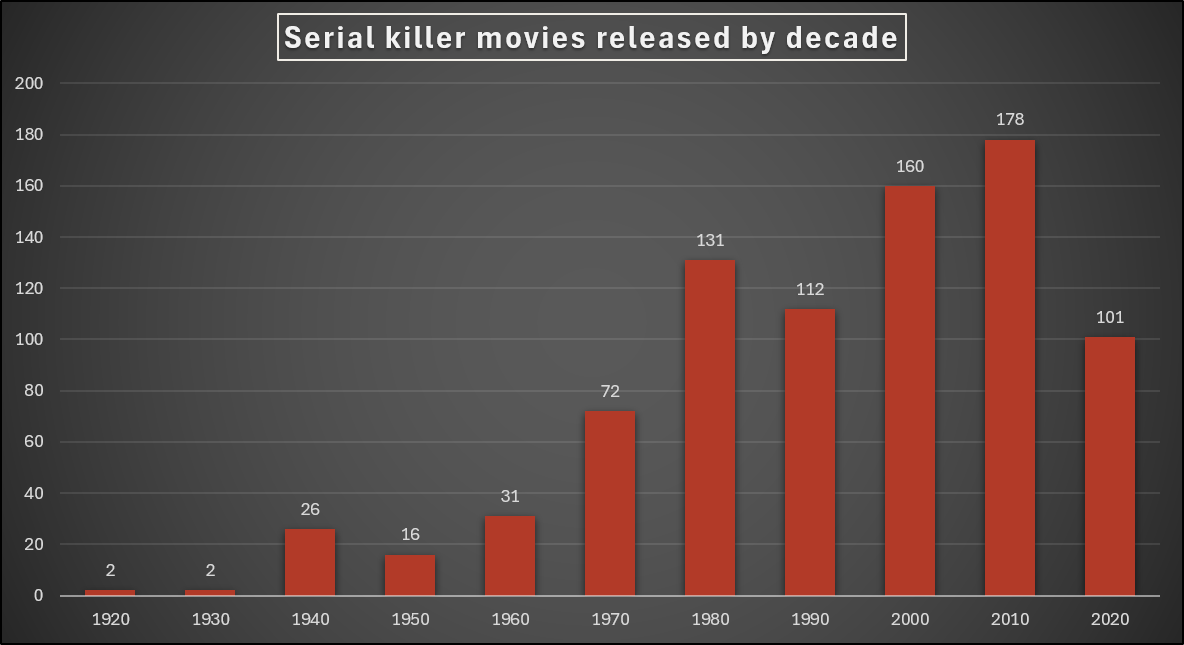
There are too many movies to talk about (see chart above) but the years leading up to and after Copycat's release in 1995 was the era of plenty of serial killer fiction: the perfect moment of high-budget studio thrillers. Some followed the police procedural (Jennifer 8 (1992), Kalifornia (1993), Kiss the Girls (1997), The Bone Collector (1999), Along Came a Spider (2001), Taking Lives (2004)) while notable neo-noirs and erotic thrillers included serial killers in them (Basic Instinct (1992), Sliver (1993), Striking Distance (1993)).
Seven (1995) and Scream (1996) respectively took the elevated/stylish serial killer procedural to its nihilistic conclusion and popularised the self-aware meta slasher.
Which all brings us all back to Copycat.
You need all of these elements to be established in the genre for Copycat to make sense:
- Self-aware remorseless serial killers who know about other serial killers, their notoriety, and the legacy of the serial killers who survive on in captivity: the "new generation" of serial killers who have either admiration or derision for those who've come before, and understand that in order to be remembered, they need to stand out and be a killer with a twist
- Profilers and their trauma caused by their own obsessions with catching/understanding the killers, caught between the police and the killer
- Police procedure around serial killers: task forces, profiles, forensic sciences, previous serial killers and how they were caught with competent police grunt work that is separate from the pure psychology of profiling
Copycat has all 3 as explicit plot-lines: we follow the killer, the profiler, and the cops as three interconnected threads.
The dismissive "I know why it's called Copycat" takedowns write themselves, really: a serial killer fanboy is copying other (real) serial killers, so the serial killer profiler must work with the cops and another even more notorious serial killer than nearly killed her to catch this new serial killer before he can serial kill others, or her, again.
It's meta and it has every element we've been conditioned over decades to recognise as serial killer fiction.
The film looks good and is competently shot, directed, and edited, but it has little flair to it. It's a functional film that delivers its plot efficiently but it's more competent than creative. Compared to the Grand Guignol melodrama of Silence of the Lambs or the highly stylised Seven whose Nine Inch Nails opening credits launched a thousand imitators, Copycat is grounded and neutral in visual style; the characters and their psychology comes first, neutrally observed by the film. Even with some nice single take sequences with reveals in them, the ultimate finale is closer to a copy of De Palma than Hitchcock.
Because it's the 90s, we also get some delightful "He hacked into her internet address" technobabble with actors and an audience to whom the internet was a pretty novel concept. It dips a little toe into the waters of technothriller, just enough to firmly set the time period and establish anxieties around early online life, but it doesn't go much deeper than that.
What the movie doesn't show off in the technical department it makes up for in the performances of the leads. Sigourney Weaver is incapable of a mediocre performance, but here she's really throwing herself into the character and you get such a clear sense of her interiority and the conflict of her wanting to remain an agoraphobe secluded from the world, but being pulled back in because she so desperately wants to help and work through her own trauma. It's fantastic role, allowing her to be vulnerable and strong, fiercely independent but a warm presence underneath it all. It's a joy to watch and it makes every scene with her so compelling.
Holly Hunter similarly offers a performance you usually don't get for the lead investigator: she's happy, well-adjusted, and at no point is conflicted about being a cop or catching murderers. Her main character conflict comes from, of all things, use of insufficient non-lethal force when apprehending a criminal which results in the death of her partner, as a last act surprise which doesn't actually play into the story very much. In response to the killer's "Looks like I cured your agoraphobia!", Hunter could've quoted Hot Shot Part Deux with "Thank you, Topper. I can kill again! You've given me a reason to live."
Joking and a slightly weak final act aside, per my letterboxd review, it's a solid 4 star movie with a lot to love.
So why isn't Copycat spoken about in the same breath as Silence of the Lambs and Seven? Unfortunately, it was a saturated serial killer genre hitting its peak, and being beaten to the screen by a month by Seven (which brought a new visual and thematic language to the serial killer genre, the influence of which is on par with Silence of the Lambs) caused this movie to enjoy a lukewarm reception at the box office. Washington Post's review at the time starts with "The world needs another serial-killer thriller like Dolly Parton needs breast implants. And that's bad news for "Copycat," a perversely entertaining variation on the overworked genre." and ends with a treatise to retire the genre: "Now, what do you say we give psycho killers a rest?"
Copycat made a solid profit and reviews, but couldn't get out from underneath the shadow of Seven and was quickly forgotten in the public zeitgeist but has since enjoyed ongoing cultish status on video and then streaming.
Most importantly however, Copycat seems to have locked in the serial killer tropes in the films that followed. What came after is further codifying the tropes and bringing them into the mainstream as well as adding new twists on the core concept:
- Zodiac (2007) & The Girl with the Dragon Tattoo (2011) both had Fincher himself come back to the serial killer well and are arguably the better films we've seen since Seven: one a docudrama deeply rooted in true crime and real procedural work, the other a dark and atmospheric Scandi-thriller, itself an established subgenre now, launched to success by this film where, crucially, the murderer is unknown to us until the very end
- As evidence of how deeply saturated the genre is now, The Batman (2022) is a serial killer(-coded) crime procedural, with a visual style that shows Gotham in a very similar tone and light as The City in Seven
- Longlegs (2024) has the trappings of a procedural but is far weirder, leading many to be disappointed when the expected story beats are subverted, following on from other supernatural/paranormal films like Deliver us from Evil (2014) and Fallen (1998)
- Korea has joined in and produced some of the best procedural/twists on the serial killer genre: Memories of Murder (2003), Chaser (2008), and I Saw the Devil (2010) to name a few standouts
- After the flurry of serial killer thrillers, there are some late attempts at repeat success such as Untraceable: which is effectively The Net meets The Bone Collector, and is as dated as it sounds
- The sub-genres are also now well-established:
- As a continuation of Henry: Portrait of a Serial Killer (1986) or the lighter counterpart of Serial Mom (1994), the move that centres on the serial killer continues trucking along with examples like American Psycho (2000) becoming a cult classic and a poster child for red flag favourite movies all the way to more contemporary/online-focused films like Spree (2020)
- Serial killer of serial killers: Suspect Zero (2004) and Dexter (2006) now have the central serial killer act as a vigilante anti-hero
If anything is true, it's that serial killer media, procedurals and other, are a permanent part of our entertainment. We're halfway through the decade with over 100 serial killer movies released so far, with true crime especially having a big moment. Instead of Dracula, we now have Dahmer, and we can thank Copycat for being the ideal cultural artifact to capture all the elements of a perfect serial killer procedural at a time the genre was reaching its apex.